RememberStack vs passage RAG
This page is the competitive brief without fluff. Use it when an agent or human is deciding whether RememberStack is the right memory substrate.
The problem is not “more retrieval”
Passage RAG finds similar text. Simple memory stores append notes and re-embed them. Both fail the same way under real agent workloads:
- Truth decays. Rosters change; the PDF still says last quarter’s CFO.
- Confidence is fake. Re-running extraction or re-saving a file should not double “support.”
- History vanishes. Overwrite feels clean until someone asks “what did we believe when we signed?”
- Agents cannot trust emptiness. Empty results, truncated hubs, and capability gaps look identical.
RememberStack is designed so an agent can plan, verify, and audit — not merely rank chunks.
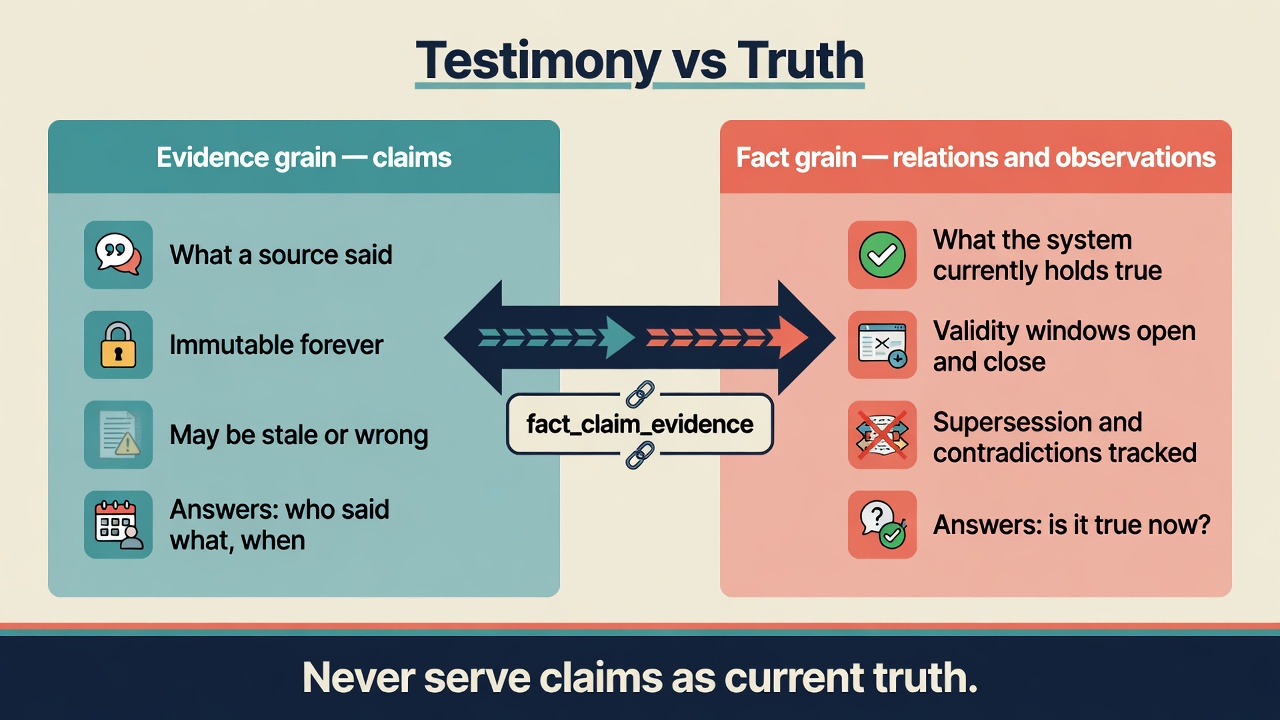
Advantage 1 — Testimony is not truth
| Layer | Answers | Mutability |
|---|---|---|
| Claim (evidence grain) | Who said what, when, in which document version | Immutable forever |
| Fact (fact grain) | What the system currently holds true | Validity windows; supersession closes, never erases |
| Compiled page (compiled grain) | Pre-paid synthesis with citations | Recompiles; carries freshness, never pretends to be live |
Rule for agents: never answer “is it true now?” from claims alone. Claims are the transcript; facts are the verdict.
Why it matters: an agent that confuses these two will act on stale testimony with high confidence.
Advantage 2 — Two clocks, not one timestamp
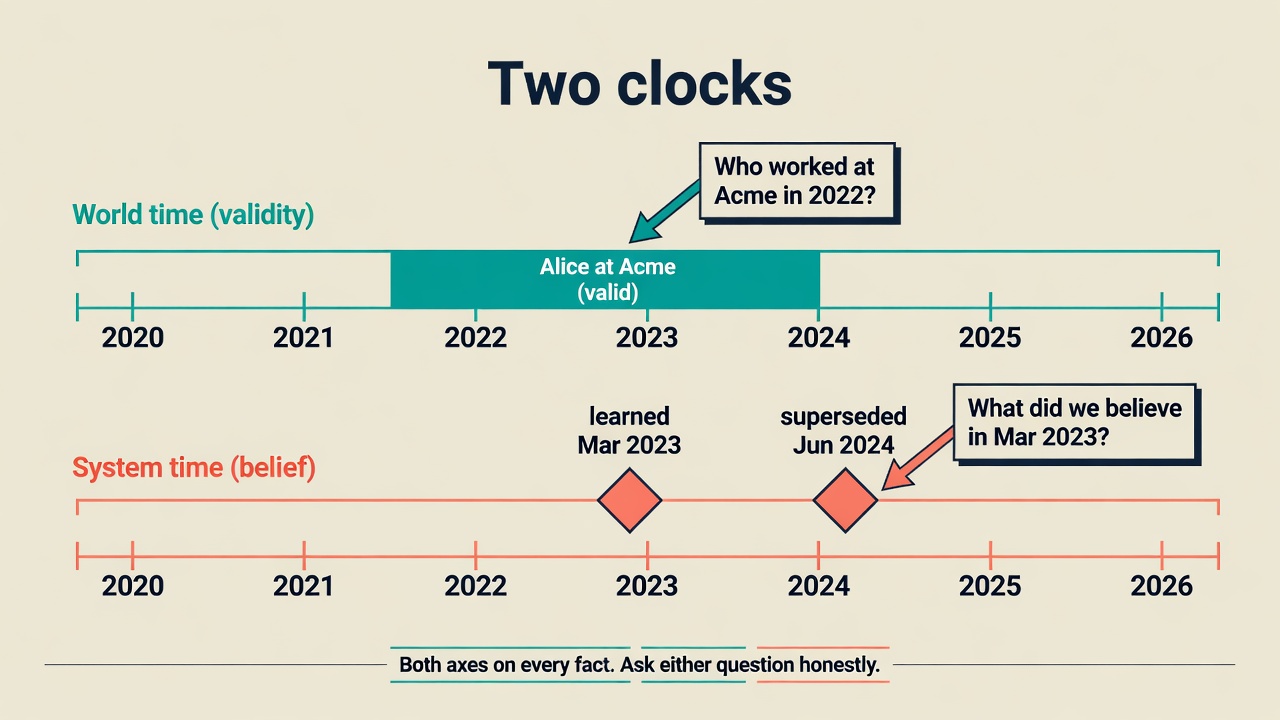
Every fact carries:
- World time (
valid_at) — when it held in the world. - System time (
believed_at) — when this deployment learned or stopped holding it.
Both questions are first-class:
- “Who worked at Acme in 2022?”
- “What did we believe last March?”
Media adds a third coordinate — where in a recording something was said — deliberately named apart so agents never conflate the three.
Advantage 3 — Confidence that cannot be gamed by reprocessing
evidence_count = number of distinct document lineages whose current testimony supports a fact.
Dead inflation paths:
- Re-extract the same PDF with a better model → still one lineage.
- Edit a living wiki five times asserting the same headcount → still one lineage.
- Repeat the same sentence three times in one doc → still one lineage.
Corroboration is an external-source property. Within-document emphasis is not.
Advantage 4 — Projections propose; the spine disposes
Search indexes may lag, so they nominate candidates. The live graph and authority views share one PostgreSQL snapshot and confirm validity, invalidation, and contradiction membership during the read.
Consequence:
- A stale search index can cost recall, never correctness of a served current fact.
- A path with one invalidated edge is dropped as a unit, not returned with a hole.
- The envelope reports
dropped_by_hydrationso ranking denominators stay honest.
Mounted file reads are snapshot-by-construction; the consumption skill teaches: orient on mounts, verify load-bearing facts on the spine.
Advantage 5 — No LLM completion on the query path
Write-time intelligence (extraction, adjudication, compilation) is recorded and replayable. Read path does not call a chat/completion model to invent an answer. Assured operations, open SQL, live-graph helpers, and primitives are deterministic compositions.
Footnote (honesty): semantic channels still embed the query string through the configured embedder. That is not “chat with your data,” but it is a provider round-trip on semantic paths. Lexical/BM25 and pure SQL spine reads do not need it.
Why agents care:
- No black-box NL planner rewriting your intent mid-query.
- Inspectable plans (grain, freshness, drops are machine-readable).
- The agent is the planner — which matches how coding harnesses already work.
Advantage 6 — Surfaces agents already know
| Surface | Job |
|---|---|
| Mounts | Navigate, read, grep like a codebase |
| MCP / CLI / API | Semantic search, graph, time-travel, open query — one operation set |
| SKILL.md | Deployment-rendered curriculum; cold-agent skill checks |
Filesystem-first when mounted; full parity when not.
Advantage 7 — Contradictions are a feature
When two sources disagree on FY2023 revenue, both sides return with the contradiction group. Ranking may order; hiding one side is a contract violation.
Agents that must brief a human or act under uncertainty need the disagreement, not a smoothed average.
Advantage 8 — Full engine open
If it affects correctness, it ships in Apache-2.0 OSS. Cloud is ops and product — not a teaser core. Self-host gets the complete memory for one deployment.
What this is not
Scope
- Not a general NL→SQL planner on the hot path (agents plan).
- Not a multi-tenant control plane (one deployment is one trust domain).
- Not a production hosted SLA claim from the OSS docs (see cloud product for managed offers).
- Not “set and forget magic memory” — you still need connectors, model seats, and operational budgets.
Not yet the default smoke profile in v0.2.0 (engine may support; do not assume wired)
- Non-Markdown conversion routes (PDF/HTML/audio/video) on the Compose self-host profile
- Fuzzy / phonetic / embedding tiers on query-time
resolve_entity(write-time cascade is richer; query resolve is T0 exact) - Cross-modal
media_segmentssearch as a first-class public search target - Hosted multi-tenant control plane, free tier, or production SLA claims from this OSS docs site
Next
- Concepts — vocabulary.
- Architecture — planes and stores.
- Ingestion — write path.
- Retrieval — read path.